Party Culture

Potentially unpopular opinion: contemporary party culture sucks.

I feel like there is some unspoken understanding that says the best nights of your life are the ones you don’t remember. There is a certain pride that goes with drinking alcohol to a point where you are no longer physically or mentally capable to function. Isn’t that kind of sad? We define some of the best moments of our lives as those that we can’t even remember what happened, what we did, who we were with, and how we felt. And then we relive and piece together those memories using 5 second clips on Snapchat and Instagram. If I am at a party, why do some friends insist that I black out or otherwise end up incapacitated. Why am I suddenly a lame-o if I would rather share a meaningful experience with people I care about instead of testing the limits of my metabolism (I have some ideas why, but maybe it’s too soon). I’m not claiming to be above any of this nor am I trying to tell anyone how to live their life, but I am trying to point out how ridiculous it kind of is.

All that being said if a certain lifestyle makes you happy, and I mean truly happy, then more power to you. If you resonate with any of this, where do we go from here. If you disagree or are upset by any of this, why do you think that is? Perhaps this has less to do with a culture of partying and more with culture of escapism. Everything feels better when we can forget about our problems, our anxieties, our fears, and our responsibilities, but there has to be, and are, better, less destructive ways to do that. Forgetting and avoiding is the easy way, but doesn’t fix anything; confronting and resolving, is much harder, but may fix everything. Pick your poison.

Thoughts on “The Spiderman Paradox”

In one of Seth’s recent posts, he talked about the famous Uncle Ben saying, “With great power, comes great responsibility,” and how rather than embracing their power, people end up repressing it in fear of the responsibility that goes with it.

Once again that theme of fear as the great inhibitor comes up. We’re afraid to stand out, afraid to make a change, afraid to challenge the status quo, because to do any of those things is to become vulnerable. By making a choice to be different we open ourselves up to scrutiny and to blame if things don’t work out the way we hoped. Or perhaps even more frightening, if things might turn out exactly as we hoped, then we are expected to take on more responsibility with a proportionately increased expectation to succeed. Win or lose, action comes with that burden, all we need to do is accept it. Fortunately, I think taking responsibility for one’s own actions is almost universally respected (which kinda makes me think about certain groups/ individuals who I have little respect for who want all the power and none of the responsibility). And to refuse that responsibility is to give in to powerlessness and inaction, at which point you are basically a vegetable. But even vegetables do as much as they can given their circumstance, so you’d actually be doing less than a vegetable. Think about that…


The Self-Love Fallacy

I was talking with one of my very good friends, Aaron, the other day on our drive home from Six Flags Magic Mountain (there you got your shout-out), and as we often do, we got deep in a conversation about a variety of stuff. One topic in particular that we were talking about was the idea of being happy with or for yourself rather than trying to find happiness in others.

Like with most things I think the ultimate idea of this is all well and good, but also like with most things I want to talk a bit more specifically about what the words mean and how people may interpret them.

Self-confidence and self-esteem are of utmost importance for an individual. There is a sweet spot here though. Too much confidence and your verge on arrogance and self-centeredness; too little and you can introduce a whole set of personal problems. Today we are often told that our self-worth and our confidence should come from within ourselves and I believe that to be true to an extent. However, we often take that to mean treating ourselves and buying nice clothes for ourselves so we can feel good. This idea of self-love and self-care leads to confidence that is grounded in our possessions, appearance, and other superficial metrics. I’m not saying we shouldn’t do nice things for ourselves, but that should not be the basis of how we care for ourselves.

Personally, a lot of my self-love comes from my volunteer work. In Doctors Without Walls, whenever a person we work with expresses their gratitude for what we do, my mentor always says to me afterward, “That’s the paycheck right there.” I don’t think this feeling is in anyway unique to me or the people I work with. Everyone has a sense of this, but contemporary culture has a specific image of what self-love is and that typically does not include doing something nice for someone else.

If it makes someone feel good than when they can make another person else feel better or make another person else feel happy, does that mean they rely on others for their happiness? If it does, what’s wrong with that (of course at the extreme we can get into compassion fatigue; again moderation is key)? We are social creatures by nature and I think some of our happiest moments come when there are other people in our lives. I think idea behind self-worth and self-love is being happy during the in-betweens. Our relationships and interactions with other people should not determine our self-worth, but I think it definitely can be a part of it and I think we should embrace that.

Happiness does not have to come from others, but that does not mean it shouldn’t.

Lessons and ‘Lutions 2019

Wow we haven’t spoken since last year!

thx for my steam profile pic

K now that that’s out of our system lets talk lessons and ‘lutions. This post isn’t about the semantics or effectiveness of setting goals for the new year, because I think any opportunity to try and better oneself is good and if that means setting a starting point like the new year, so be it (end rant). Anyway 2018 was a big year for me in terms of personal and professional goals. I think this blog is somewhat of an archive of some of the lessons I’ve learned and ideas I’ve mulled, so rather than detail that, I want to talk about the future.

So here is a list of things I hope to accomplish in 2019:

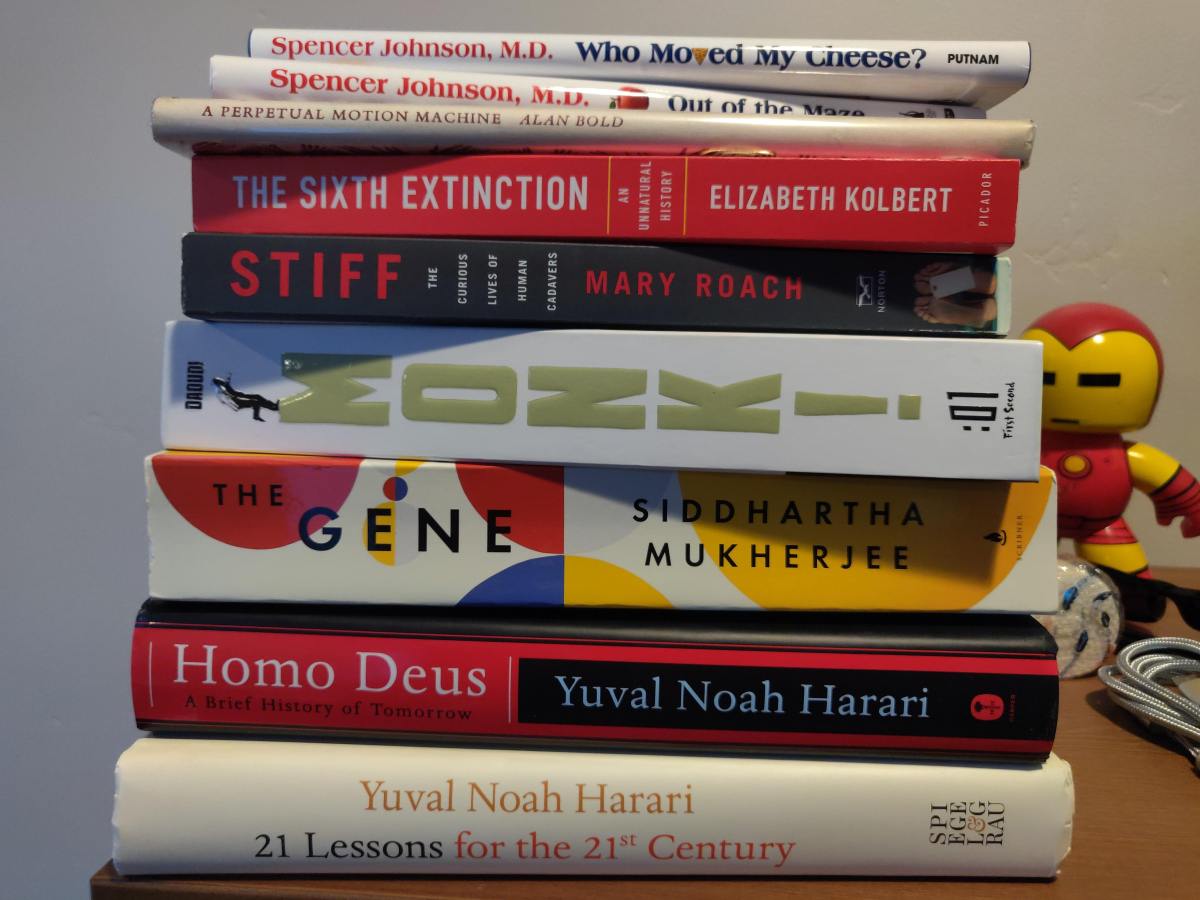
READING – I collected a very exciting stack of literature in 2018, especially during this past holiday season, some of which is in the photo above. I’m starting with The Gene. If anyone has read any of these, or plans to, let me know, I’d love to have a discussion partner!

Get a podcast of the ground – I participated in a podcasting fellowship of sorts this past summer, but wasn’t able to be as involved as I would have liked due to MD school apps and other obligations. Now that I have a bit more time I really want to get started on this, maybe even collaborate with my sister (http://www.frankievictoria.com/blog/).

Get into Medical School – Applications are in, now I just have to go through interviews. Feeling nervous because I have so far only gotten an interview at 2 of the ~20 schools I applied to. Hopefully I hear back (yay or nay) from the rest soon. In the end, all it takes is one yes.

Travel – Once the dust settles on all the MD school stuff I really want to go somewhere. Not sure where, thinking somewhere in Asia, but I don’t know. This will kind of be my last opportunity to really travel for a while if I do get in this year.


That’s major stuff, if I end up thinking of others I’ll probably come back and add them in for myself. Do you have any thoughts on New Year goals? Did you make any?

Sincerely,

Niko

“Better and Bad”

Result from the rest of the world.

I’m on a new book now titled Factfullness with the subtitle “Ten Reasons We’re Wrong About the World–and Why Things Are Better Than You Think.” One of the main points of the book is that we (especially people who live in relative wealth [defined as >$32 per day]) have a tendency to see the world worse than it is. He bases this on years of surveying various groups including professionals in international relations (read the book if you want more details). This is not to say that we should stop worrying about the state of the world or that we should stop trying to improve things. Rather we need to focus our efforts appropriately.

Without getting into a philosophical discussion on what is truth/ reality/ objective/ fact, data tells a story, and one can argue that data and statistics give us the closest thing we have to “truth.” And the data shows how much progress we’ve made in medicine, in education, in public health, in conservation etc. While some of this progress seems obvious, educated people consistently performed worse than random on the multiple choice surveys asking questions about the current state of the world.

Anyways, the author, Hans Rosling, talks about things being simultaneously better and bad. Just because there is some messed up shit in our present world doesn’t mean things aren’t better than they were. If we want to continue making things better, we must proceed with a clear picture of our present and a clear vision for our future. And just as looking back through history at our mistakes serve as lessons on what not to do, looking at how far we’ve come is important to knowing where we should go and how we should get there. Thoughts?

Smile

I try to make it a point to smile a lot and I think everyone should. Not in a “You’d be handsomer/ prettier if you smiled” type of way. Smiling just makes me feel good; it’s free and it’s a really easy way to spread a little joy around, which I think we all could use a little more of. Obviously there are situations and circumstances when smiling may be not a great idea or perhaps be inappropriate, but I think only good things can come from being bit more (responsibly) liberal with our smiling capabilities, even if that means just smiling to ourselves every now and then.

BONUS: Here’s a TED Talk about smiling

Emotional Objectivity

When people talk about being objective, it usual means sticking to the facts and disregarding emotion. For a long time I thought that “objective” was generally superior to “subjective.” This is something I talked about in a previous post but I want to expand on it a bit. The common definition of objective seems to de-value emotion. Emotion is often associated with immaturity and naivete, which I think is a disservice to emotion itself and ultimately to how people interact with each other.

Emotions are, in a sense, objective. Feelings exists whether or not their trigger is factual or fabricated, and they are connected to physiological phenomena. Culture or past experience has trained my brain to respond emotionally to this situation, and that is a fact. I cannot change my brain to immediately feel something different.

Today so many people, including myself, look to “objective,” evidence-based solutions to problems. We try to filter out emotion because it muddles up the “truth.” What I’m advocating for here is, rather that filtering out the feelings and the emotions, acknowledge them. Recognize your own emotions and the emotions of others because if we want to effectively communicate science and facts we first need to establish human connections. And those connections are made through feelings, not facts.

No Job I’m Too Good For

I’m convinced that there’s no job out there that I’m too good for or that I’m overqualified for. If I have the ability to perform a task that I am simply qualified to do it. Perhaps it does not utilize my entire skill-set, but that doesn’t mean that work is beneath me.

We should delegate work and specialize for the sake of efficiency and quality, not for status and prestige. If there is a something to be done and I’m capable and available, and no one more qualified than me is, I’ll do it.

When we start to believe we are too good for something, it can be easy to become jaded, ungrateful, and dissatisfied. Ultimately it comes down to attitude; I can either look at something as a chore or as an opportunity, and that’s completely up to me.

The What and the How

The what is the facts. What information do you have to offer. Hopefully its accurate and important.

The how is the delivery. How do you get your point across. Hopefully its effective.

Used to be obsessed exclusively with the what. Facts were the only thing that mattered. My perspective was the only logical one, and logic is indisputable!

But not everyone in the world grew up similarly to me. And even if they did that doesn’t mean anything. My siblings have different worldviews than me! Individuals’ lived experiences inform what is logical to them. And once I recognized that, I became less concerned with the what and more with the how.

I am by no means an expert on the how but I think recognition is a good first step, and I think I’m getting better.

And don’t get me wrong, the what is still super important. Having accurate and truthful facts is important, but at the end of the day will live in a world with humans, and those facts can be virtually meaningless unless you can convince the person sitting across from you that those facts are trustworthy and why those facts matter.