Dividends

What things are worth investing in? How do we determine what has value and what doesn’t? It’s all almost completely subjective. Even money, the standard by which we value things, only has value because everyone agrees it does.

My 13 year old cause just bought a pair of $300 shoes. Personally, I don’t think I could every justify such a purchase, but I can’t blame him. Obviously to him, those shoes were worth every penny. I’m sure in my life I’ve placed value in things that may be equally unfathomable to others, but to each his own right?

So then what is it I value? I have a whole year to do almost anything I want, the question is what should I do? What should I invest in? Right now I’m working, but my job lets me work remotely. I want to use that freedom and move around a bit and do things that I won’t really get a chance to do when medical school starts. But I have no idea where to start. If you have any tips, pointers, or suggestion please do reach out. I’d be happy to hear from you <3.

So what’s new?

I was working in the coffee shop today and this couple took a seat at the table next to me. They didn’t seem to be a romantic couple (yet), but more like old friends who haven’t seen each other in a long time. They sat there for a long time catching up. The conversation flowed quite nicely. Heck there were times that I wanted to jump in, but I restrained myself. I thought to myself, Why can’t more conversations be like that? Maybe it’s ’cause I can be a bit socially awkward at times, but thinking of stuff to say can be hard at times, and I am very comfortable with silence.

I’ve got a bad habit of always responding to the titular question with, “Not much. How ’bout you?” Similar to “How are you?” (see my post on that here), the response has become so automated that even if there is something new I won’t say it because my Pavlovian response comes out first. Even if it has become a standard greeting and a perhaps lazy attempt to gain access into another’s personal life, it is still an attempt, and I would like to respond in earnest. Can I really not think of anything new that has happened to me since the last time I’ve seen this person? Either I need to think a little harder or need to do more new things, both of which could only be good. But also don’t ask those questions if you don’t really care about the answer. We should be mindful of our attempts to strengthen our interpersonal relationships.

So here’s to actually thinking of stuff to say when people ask things like that, even if they aren’t expecting it, ’cause they should.

JDI

I’ve been slacking quite a bit these past few weeks. I don’t really have a good reason. Writing something every day isn’t hard, writing something good every day can be. But I’m not trying to write good (get it?), I’m just trying to write. Writing is free, it just requires a time investment, but even the size of that investment is totally up to me. What holds me back is either me getting caught up with something else and I forget, or I can’t think of something to write. Or a lot of times I can think of something to write, but as I write it or as I think about it, I realize how vulnerable I would make myself by publishing it. Sometimes I don’t even want to go back and proofread because I think I’ll chicken out as I reread it. Not many people read this, but the ones that I know who do, I consider pretty close to me. Even though those people may know a lot about me already, there some things that I struggle to say outloud or even type out. Telling someone what I believe or how I feel is a risk. There no way to predict another person’s reaction perfectly. What if what I say jeopardizes that relationship?

I consider myself a pretty understanding, empathetic, and open-minded person, so if someone comes at me with an opposing viewpoint I feel like I would try to make them feel heard, even if I don’t agree with them in the end. The thing is I don’t think most people are like that. I’m not trying to be self-righteous, that’s just what I’ve experienced. Many people are willing to be heard (they love that shit), but not many are as willing to listen.

I want this to be a space where I can voice my opinions and thoughts, and if people want to have a real discussion about it they should engage with me. It’s uncomfortable to bring beliefs out in the open, and it’s uncomfortable to have those beliefs be challenged, but that’s the only way we can move towards understanding and truth.

The Form

The idea of “the Forms,” a la Plato, has always been interesting to me. My understanding is that at its simplest, it says that everything in reality is based on some ideal, true, form of which reality is merely a shadow (literally in the famous allegory of the cave). This brings some type of objectivity to our world that may otherwise might be absent. Of course it depends on whether or not you believe in such forms.

Anyways, that’s not what I wanted to talk about. I wanted to talk about forms as we may apply them to ourselves. We all have this picture of our ideal self, in our ideal life. What does that look like? And what steps get us closer to that realization.

I’m struggling on what to write next though, because there is a bit of a paradox. Maintaining this idea of a form creates an expectation-reality gap. But what if part of the form I envision form myself includes self-acceptance. Can I be happy with myself, but still want to improve? The ardent optimist/ possiblist in me says of course you can! Wanting to improve can mean accepting yourself now, but wanting better for yourself in the future. But doesn’t that imply discontent in the present? If I ever get to where I want to be will that be enough? Just like with the forms our reality maintains an asymptotic relationship with our ideal self, it can get closer and closer, but never truly reach it. But again that depends on what you believe.

Here’s where I think I land, and literally this is just my thoughts as they are coming to me, I haven’t thought about it this way before: The current form I had in mind was one without discontent. It assumed that acceptance means fully content, but that is not the case. Just like you can’t have happy without sad, courage without fear, etc; satisfaction/ being content requires a conception of dissatisfaction. Acceptance is the acknowledgement of that duality, and the duality (or plurality) of all things.

Focus

Everyone is hyper-self-conscious of their own flaws, physical, mental, etc. Sometimes the smallest comments about those flaws can deeply affect our state-of-mind at a given moment and beyond. For me, even if it’s a joke or a verbal slip by another person, and even if I know it’s a stupid thing to get hung up on, that doesn’t really help. My brain is fixated on it because prior to that comment, I could have believed that this thing that I am self-conscious about only exists in my head, but that comment brings it out into the real world.

With that, I also should try to be more conscious about the things I say because everyone has their own insecurities, and no one needs to have them highlighted outside of their control.

The Animation Reformation

I recently watch the new 2019 Lion King live-action remake. Obviously, it’s not actually live-action in the literal sense, but it might as well have been. The images were hyper-realistic and honestly beautiful. And while I enjoyed the movie, I couldn’t help but miss the fantastic whimsy of traditional animation. Animation is fun cause there are almost no rules, and in that way has a life of its own. With animation your mind can break free of the limitations of reality (not that talking lions and organized monarchical animal societies have a strong basis in reality). 

It’s fun to relive some of these childhood classics in a new way, but nowadays everything is a sequel or a live-action remake, and fatigue is settling-in, and it doesn’t help that some of these movies are just bad. But even with amazingly good one like Toy Story 4, I am still yearning for something fresh.

At one point in painting, realism was the epitome of artistic skill, but eventually fatigue set in, giving rise to more abstract art (at least that’s my understanding, I take one art history class and all of a sudden I think I’m an expert, so art people please put me in my place). It was fresh, unlikely anything anyone was doing at the time. Now in cinema, particularly in animation, we are at a point where realism seems to be the primary objective, not just visually but thematically as well. Toys are having existential crises, evil sorceresses are battling for custody, etc. Sure relatability and sympathetic situations in stories aren’t new ideas, but now I feel like they are more thinly veiled than ever.  Disney et al. will continue to milk their dead cow, and chances people will continue to lap it up straight from the teet, but just like in other forms of art, people are getting tired, and a storm’s a brewin’. An animation renaissance is coming, and it will be spectacular.

July 23

To the most important woman in my life.

Who taught me how to walk and how to talk

Who taught me how to love

Who taught me never to give up on others, no matter how lost they may seem

To the woman whose smile

Tells me everything is going to be ok

And whose hugs

Squeeze all the hurt away

Thank you and I love you

Happy Birthday

Mi Pecado Capital

I recently finished Season 3 of The Seven Deadly Sins on Netflix. I actually watched it with the Spanish dub in my effort to learn the language. The Seven Deadly Sins in Spanish is Los Siete Pecados Capitales (actually meaning the seven capital sins), which is really fun to say. Anyways I really enjoyed it and highly recommend it. If you look past the flashy action and perverted jokes there is some really interesting themes. This is common for a lot of animes, and usually gets me doing some introspection.

I’d say my sin is pride, though of course it’s not the only one, but it’s the one I’ve been thinking about the most recently. I don’t think I am arrogant, but I do like to be able to do things on my own, and to prove that I can do things on my own. A lot of the people I look up to, especially in my own family, had gone through their fair share of struggles to get where they are now. I on the other hand have lived a pretty charmed life, and I feel insecure about that. I have this desire to prove that I deserve all the good fortune that has come to me; that I somehow produced my own success, just like in all the famous success stories.

As I write it out, it becomes even more stupid to me. First of all, nobody does anything alone. There is always someone, or more likely someones, behind the scenes who are key to success (let me know if you can think of any counter examples). I don’t need to prove that I deserve anything to anyone because it’s not a question of whether or not I deserve something. The question is, What am I going to do with it? Just like with regret, over-pondering deservedness does little for me in the present. I have to accept and be grateful for any beneficial situation I find myself in, and use it in a productive way.

Nothing I produce could be possible without the goodwill of other. However, nothing can be produced by goodwill alone. It is my responsibility to do my part to try and convert what I’ve been given into something of equal or greater value. Denying the support and resources of those around me does not make me independent or worthy, it makes me ungrateful and naive. I’ve put too much stake in trivial displays of independence, and in doing so have failed to take the time to properly appreciate the people and the opportunities to whom I owe everything.

Disculpe me, intentaré hacer mejor proximo vez.
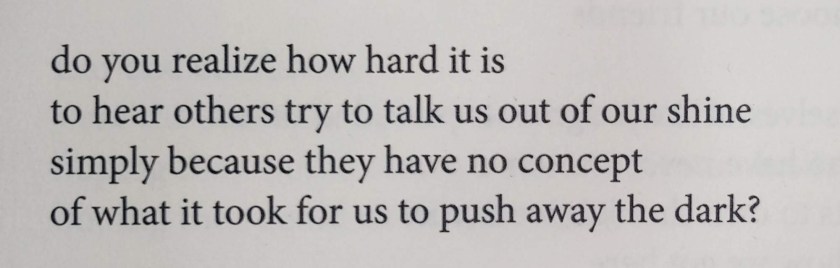
Shine

1563501767075-12765f29-2bf5-42c3-a87e-2c79eff9a5c7_

This is from a poem that I keep revisiting by Shane Koyczan titled,”What Mattered.” It’s a long one, and I was gonna put more, but separating them from their original context would be too much of an injustice. This is just one that I really love and thought was strong enough to stand alone.

It’s basically a poem about not giving a fuck. It’s about being who you are now, and who you want to be, not who you think others want you to be. I don’t want to talk about it too much because I want anyone who reads it to have their own takeaways from it, but I couldn’t find it online…. maybe I’ll read it out loud and post it <insert thinking face emoji> that’s how much I want you to read it…. probably not though.


Running Away With Me

At one point, I thought that when I had kids of my own, I would try to make sure that they grew up with a strong foundation in truth and rational thinking. Maybe I wouldn’t tell them about Santa Claus, or about the Tooth Fairy, or other (potentially) made up things. The more I thought about it, the more I thought what an injustice that would be. For me personally growing up, my imagination enriched my life. The world was more exciting when you could create your own.

Denying that at a young age won’t make the kid any smarter or logical, that’s what growing up is for. What it may do is stifle creative processes and development. (Coincidentally, I started this draft long before I read the following; this is me picking up where I left off, and it just happened to fit perfectly). For my Child Life class, I just read about how important play is for development. It’s away for kids to experiment and problem-solve in ways they can understand and control, in their own “language.” There was a quote from the textbook that I really liked that described play as figuring out “[h]ow close to reality can I portray the separation experience before I feel anxious” (Thompson et al, 148). The separation experience referring to actually parent-child separation in hospitals, but also being representative of any real world dilemma that a child faces. In other words, play is a form of acting out problems, that spares the child the need to directly confront the psychological burden of the actual problem.

Different developmental theorists have different opinions on what play should look like, or whether or not it is beneficial, but it seems like much of the research points to it being a good thing intellectually and psychologically (especially with guidance). And there’s evidence that the ability to suspend reality may be an important part of that.

So I’ll let my kid be a kid, and I’ll probably join in on the fantasies with her. And to be honest, I think we all could probably use a lil more unreality in our lives.


Thompson, R. H. (2018). The handbook of child life: A guide for pediatric psychosocial care. Charles C Thomas Publisher.